








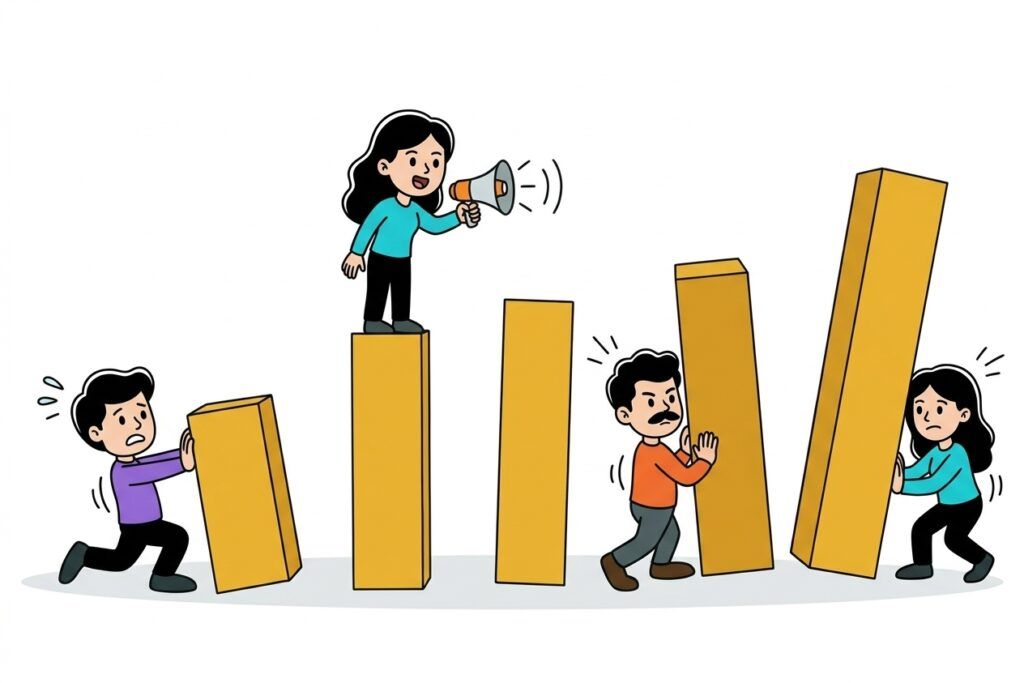
 Most companies have a performance management system. Few know whether that system actually works. It’s a question HR departments rarely ask themselves, because the answer seems obvious: “we have annual reviews, we have objectives, so we have a system.” But having a process in place doesn’t mean the process produces results. You can run evaluations consistently, have forms completed on time, hold discussions scheduled well in advance — and still end up with a team that isn’t clear on what’s expected of it, a management layer that doesn’t catch performance issues in time, and employees who feel the feedback they receive has little to do with their actual work. A performance management system isn’t effective because it exists. It’s effective because it answers three simple questions well: what you evaluate, how you evaluate it, and how you encourage performance once you’ve evaluated it.
What You Evaluate
The first sign of a system that isn’t working is that it evaluates things that are easy to measure, not things that matter. Hours logged, tasks checked off, meeting attendance — all easy to quantify, all telling you very little about actual performance. A good system starts from clear objectives, tied directly to company outcomes, not to activity for its own sake. This is where methodologies like OKRs (Objectives & Key Results) come in — qualitative objectives with measurable key results that connect each person’s work to the company’s real direction, instead of an isolated task list. The difference isn’t cosmetic: an employee who understands how their individual objective feeds into a company-wide goal works differently than one who’s simply filling out a form.
Just as important is what you’re NOT evaluating. If your system only tracks the final result, you miss everything that happened along the way — initiative, collaboration, how someone handled a difficult stretch. The end result is easy to see at the close of a quarter. The actual contribution, often, isn’t.
How You Evaluate
This brings up the second, equally important question: even if you’re evaluating the right things, are you doing it at the right time and from the right angle?
A single annual review can’t carry the full weight on its own. It’s useful for the big picture — where you started and where you ended up over a full year — but if it’s the only evaluation moment, it inevitably ends up documenting rather than correcting. By December, a problem that surfaced in March has already become a habit.
That’s why a mature system combines several types of evaluation, each with its own role:
- Quarterly check-ins and reviews, which show whether you can still change course while there’s still time — not just at the end of the cycle.
- Continuous feedback, which shows where you stand right now, not where you thought you stood a month ago.
- 360-degree evaluation, which gathers input from peers, direct reports, and managers alike, not just top-down. An employee evaluated exclusively by their direct manager gets a single perspective — useful, but incomplete. 360-degree evaluation surfaces exactly what a single observer can’t see.
None of these methods replaces the others. The problem arises when a company treats them as interchangeable — or, more often, when it has all of them “on paper” but in practice ends up relying only on the annual review, because the rest get lost along the way, scattered across emails, informal conversations, or separate documents that are hard to track and connect.
How You Encourage Performance
Evaluating the right things at the right time is only half the equation. The other half is what you do with that information once you have it.
A performance management system that stops at “the review is done” wastes most of the process’s potential. Recognizing real contribution, promptly — not just at year-end — changes behavior. Positive feedback given right after an achievement lands differently than the same appreciation mentioned in passing, six months later, in an annual review form.
It’s just as important that performance be visibly tied to progress, not just outcome. Someone who took on a difficult project, collaborated well under pressure, or found a solution to an unexpected problem deserves to see that reflected in how they’re evaluated — not just the final number they produced.
Signs Your System Isn’t Working
If you want to quickly test the system your organization currently has, a few simple questions can reveal a lot:
- Can your managers say, without checking a document, what objectives each person on their team currently has?
- Is the feedback your company gives specific and tied to concrete facts, or does it stay at the level of general impressions (“good job, keep it up”)?
- Is there a single evaluation moment per year, or is performance tracked continuously, through check-ins and ongoing feedback?
- Do employees understand how their individual objective connects to a larger company goal?
- Is evaluation data scattered across separate documents, or is there a single, easy-to-follow picture over time?
If the answer to most of these is uncertain or negative, your current system is probably running formally but not delivering what it should — clarity, direction, and a real connection between what each person does and what matters to the company.
What Actually Matters
An effective performance management system isn’t the one with the most forms or the most complex process. It’s the one where evaluation, feedback, and objectives work together, in real time, instead of living separately — an OKR in one document, verbal feedback that gets forgotten, an annual review that recaps, often too late, what actually happened.
At Co-Factor, we build exactly this kind of connection: objectives, check-ins, continuous feedback, and 360-degree evaluations brought together in one place, so performance management stops being a process isolated from the rest of the work and becomes part of it. If you recognized any of the signs of a system that merely exists but doesn’t deliver results, it’s worth taking a closer look at what you currently have — whatever you end up replacing it with.